Dreamed Up Solutions

Updated: Apr 25
When I began working on engineering problems using advanced mathematical tools and methods such as differential equations, linear algebra and matrices, Laplace and Fourier Transforms, complex analysis, etc., I began dreaming solutions while asleep. It didn't happen very often, usually only for the most difficult problems, but when dreamed solutions panned out into real-world solutions, even in part, it was always an incredibly satisfying sensation, especially when a dream became recurrent and persisted until my waking mind solved it all.

Ever since times of dreamed up solutions, I've wondered how my subconscious mind did it. Eventually I wondered if maybe I was tapping into an alternate self operating in a multiverse. A Trans-Dimensional Resonance model proposes to make sense of it all mathematically.
ABSTRACT
Current neuro-biological models classify dreaming as a closed-system process of memory consolidation. This post proposes an alternative: the Trans-Dimensional Resonance (TDR) model. TDR postulates that the human subconscious, during REM-phase decoherence, functions as a quantum receiver capable of sampling adjacent branches of the multiverse. By mapping these yielded insights through mathematical formalization, it can be demonstrated how single-dream events provide useful raw data, while recurrent dreaming acts as stabilizing Phase-Lock that validates the feasibility of trans-dimensional information transfer.
I. Single-Dream Dynamics: The Stochastic Insight Yield
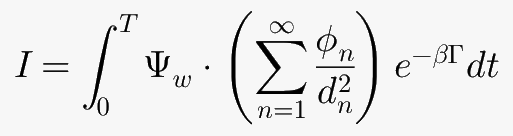
This equation is proposed as a means of expressing the single-instance solution dreaming Insight Yield ( I ).
To make sense of this balancing act, consider that each equation component represents:

In this primary state, the fantastical nature of the dream is a byproduct of Dimensional Distance (dn). Because the observer is sampling a high volume of divergent realities, the data is often fragmented. The dream feels weird because the brain is attempting to cross-reference multiple foreign physical constants simultaneously. While the yield ( I ) provides a burst of creative insight, its lack of stability makes it difficult to replicate or verify within waking baseline reality. This inherent instability leads to insight loss upon waking.
II. Recurrent Dreaming: The Multi-Node Phase-Lock
Then we have recurrent dreams which lead to more persistently recalled solutions for waking-world problems. In this phase, what was previously perceived as fantastical is revealed as Φalt: the native, logical constants of the source-multiverse. The repetition occurs because the Normalization Factor (λlocal) is gradually decreasing. As the dreamer returns to the same coordinate, the brain stops trying to correct the violet skies or the non-Euclidean architecture, eventually accepting them as baseline truths. This creates a high-fidelity data stream where complex problems can be solved using the alternative logic of a source reality.

Another equation expressing Insight Yield of recurrent solution dreaming ( IR ) is proposed, shifting the view of these dreams from single-instance records to stable wormhole connections between multiverses.
Its augmenting variables are declared as:
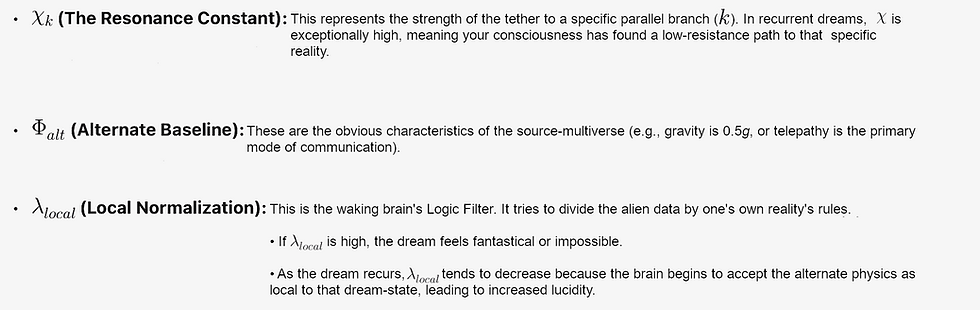
Quantum-balance occurs in the interaction between Intent and Decoherence. Seeking a solution via trans-dimensional resonance dreaming only might bring about a dream which is markedly off kilter (dn is too high), so the resulting insight becomes surreal or nonsensical. This is why dreams are commonly declared to be mere abstract metaphors since the brain is unable to map such foreign physics of a parallel branch onto one's own universal physics.
But with recurrence comes familiarity and an increasing level of lucidity, even a craving, for the off-kilter nature of solution dreaming. Then, seeking to maximize insight yield, a solution dreamer essentially needs to lower the decoherence filter (Г)—which is exactly what happens during deep, uninterrupted sleep–allowing the summation of parallel data to resonate with waking intent. Recurrent solution dreaming magnifies the effect, and while proof that our brains are tapping into the multiverse is not official, the "Aha!" moment people experience upon waking suggests something is definitely crunching the numbers while dreaming lucidly.
Both kinds of solution dreaming are extremely lucid, triggering more likely post-dream recall.
This elevated lucidity might well indicate a unification mechanism for these two dream types.

III. Conclusion: Recurrence as Feasibility Reinforcement
Singular stochastic dreaming to recurrent phase-locking transition provides a proof for the TDR model. If dreaming were merely internal neural noise, recurrence would be statistically redundant—a circular feedback loop with diminishing returns. However, the Reinforcement Principle suggests the opposite: the second state (recurrence) reinforces the feasibility of the first (single-instance solution dreaming) by demonstrating observable Coordinate Stability.
By returning to the same fantastical landscape and finding its internal logic consistent and obvious to inhabitants therein, the solution dreamer proves they are not experiencing hallucinations, but rather navigating Source Realities. Recurrence acts as the control group in the quantum experiment, turning a one-time guess into a repeatable, navigable source of trans-multiverse intelligence. Thus, the dream is not escape from reality, but expansion of it.

This all stirs thoughts of how solution dreaming might fit into the Syntonic Ontological Weft.


