Her Empire

Updated: 4 hours ago
Seeing the armadillo browsing at dusk, I wondered why it never raided the old red ant bed.
Checking the ant bed, I saw that its tunneling team had reached the caliche layer 20 ft down.
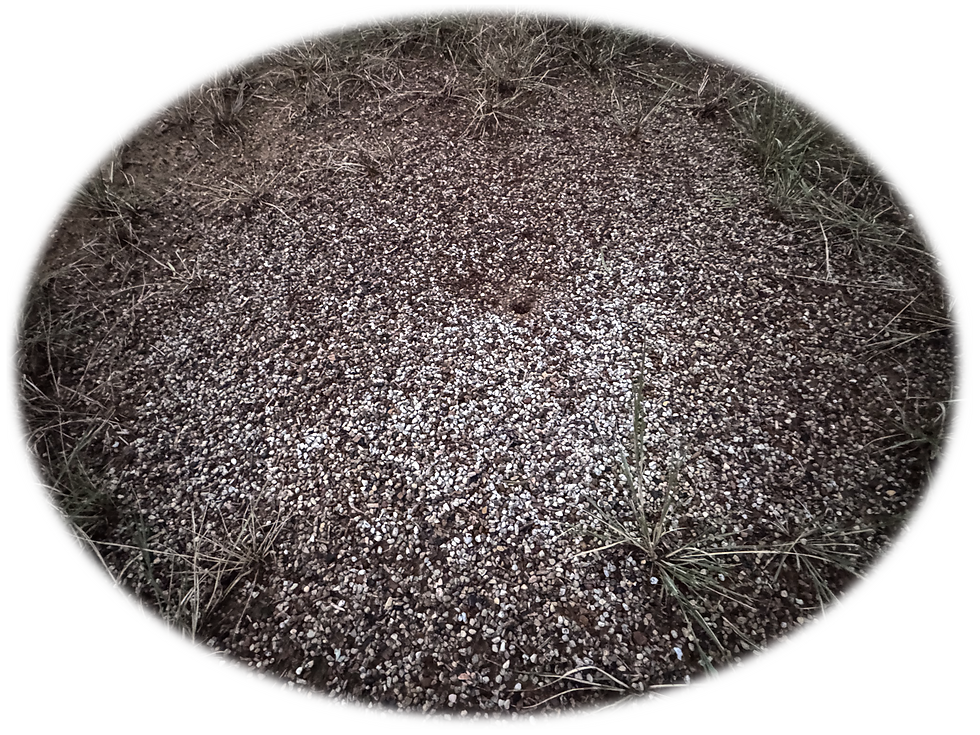
The scattering of white bits of gravel around the bed's entrance had happened just recently. Letting my mind wander about it all for a while, I suddenly realized the ant bed was at least 50 years old, possibly much older. Knowing Red Harvester colonies only last 20 to 30 years, I imagined how this one had probably grown to great extents of breadth and depth below. There must have been several colony successions for it to still be populated and active today. That meant many queens had come and gone over the decades to rule over this red ant empire. And this made me realize my life wasn't the only drama unfolding on this land.
Prologue
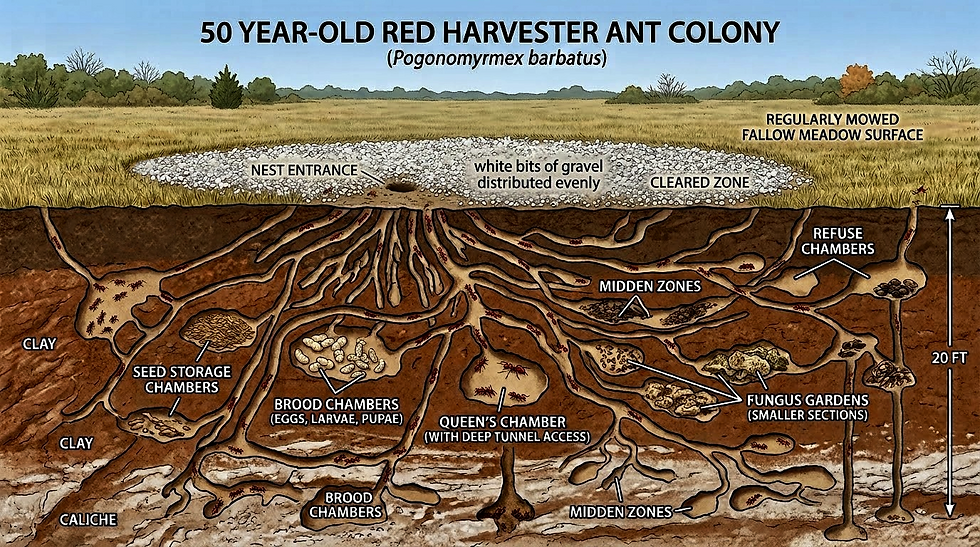
The morning sun rose over the fallow but well-tended Cross Timbers meadow, burning the dew from its regularly mowed grass and baking the clay perimeter of the ancient circular clearing into a hard, protective crust. On the surface, it appeared to be a peaceful, empty circle of bare earth. But a foot beneath the dirt, a grand lineage was coming to an end.
The old queen was dead.
Deep in subterranean darkness, her final, fading generation of daughters was growing weak. Without their mother’s royal pheromones to organize them, the colony was slipping into a quiet, leaderless twilight. Yet, the physical fortress she had left behind—a massive, multi-tiered labyrinth descending ten feet into the clay and bedrock surface strata—stood as a testament to untold decades of relentless engineering. It was a monument of tunnels, nursery galleries, and deep, dry storage chambers packed with a half-century’s worth of gathered seed vaults.
At the western edge of the bare-earth clearing, mowed grass rustled almost imperceptibly, and a heavily armored shape blundered into the open. A nine-banded armadillo (Dasypus novemcinctus), probed with its sensitive snout pressed tight to the soil as it grunted contentedly and sniffed through the mowed stubble.
The armadillo did not care about the history of the nest. It was blindly hunting. Catching the rich, oily scent of wild flower seeds, it used its powerful, curved claws to easily scrape away a shallow layer of topsoil near a foraging trail, breaching one of the colony's near-surface seed vaults. With a long, flicking, mucus-coated tongue, the mammal lapped up hundreds of stored seeds alongside a dozen sluggish, elderly worker ants toiling at the end of their lives.
A few ancient defender ants rushed the intruder, swarming over its legs and sinking their stingers into its flesh. But the armadillo was indifferent. Its tough skin and the thick, overlapping dermal plates of its boney carapace formed an impenetrable shield against the burning formic acid. It casually chewed the crunchy seeds and ants, a minor, incidental raiding force in the meadow.
Yet, the hard-baked clay of the harvester bed did not yield easily. The armadillo’s claws scraped against the brick-like dirt of the main mound, finding it tedious and stubborn. Its opportunistic instincts pulled it elsewhere. Harvester ants were small, angry, and packed a venomous sting; just fifty yards away, the soft, damp soil beneath a decaying mesquite log promised fat, juicy beetle grubs and tender earthworms that required half the digging effort. With a low grunt, the armored beast turned its back on the ancient mound and shuffled back into toward the stream side brush, leaving the core underground architecture of the historic colony completely intact.
Silence settled over the mound once more, a stark contrast to the lively mornings of decades past. Long ago, the perimeter of this very ant bed had been a bustling, high-stakes hunting ground. In the early years of the meadow, horned lizards—the iconic "horny toads"—had been prolific. They were the true, hyper-specialized predators of the red harvester ant, possessing a biological immunity to the ant’s potent venom and a stomach designed to neutralize their stings. A single lizard would sit patiently at the edge of a trunk trail for hours, systematically lapping up hundreds of workers a day, acting as a natural check on the colony's size.
But the horned lizards had vanished from the meadow long ago. Although the farn the meadow was situated on had maintained as much of the natural environment possible, the little spiked lizards had long ago abandoned this once bountiful feeding territory.
Their disappearance was a quiet ecological tragedy, driven by the rapid, aggressive encroachment of the Red Imported Fire Ant (Solenopsis invicta) across the Cross Timbers region. The invasive fire ants had actively outcompeted the native harvester ants for food, diminishing the horned lizard's primary source of sustenance. Worse, the aggressive fire ant swarms routinely raided the shallow, underground nests where horned lizards laid their eggs, destroying the next generation before it could even hatch. Combined with human pesticide use which inadvertently poisoned their food supply, the specialized lizards simply could not adapt. They had long since faded into history, leaving the meadow’s grassy expanse a little emptier.
Now, the old harvester colony sat vulnerable, leaderless, and surrounded by a changing world. But deep within the womb of a neighboring kingdom, a princess was being fed a royal diet of protein supplements. Her wings were budding. A summer rain was coming, and her quest to claim this vacant, ancient fortress was about to begin.
Empire Genesis
Inside the deep, humid clay labyrinth beneath the Cross Timbers meadow, a princess was born into total darkness. She did not open eyes to see her kingdom; she sensed it through the rhythmic, stroking antennae and chemical signals of her nurse sisters.
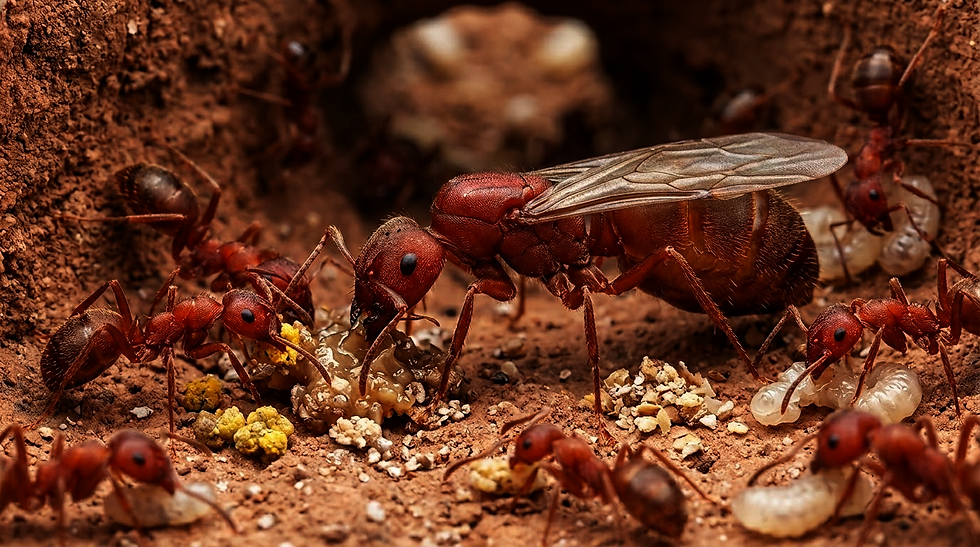
To the worker ants, she was not just another larva. Her chemical signature hummed with royal potential. Day after day, the colony’s specialized foragers brought her the ultimate prize of their harvests: the oily, protein-dense hearts of wild sunflower seeds, carbohydrates-packed hackberry fruits and the soft, rich, fatty tissues of grubs and field crickets. While her thousands of worker siblings were fed a meager, standard diet, the nurse ants stuffed the princess with these rare nutritional supplements. The rich food triggered a dormant genetic cascade. Her body ballooned to four times the size of a standard worker, and along her thorax, were a pair of translucent, tightly folded lace wings. By mid-summer, she had emerged from her pupal casing as a fully formed alate—a winged princess. For weeks, she waited in the lower galleries, fat, glossy, and heavily guarded. Precious life beyond compare.
Then came the early autumn deluge. A violent thunderstorm cracked across the sky, soaking the parched meadow. The next morning, the sun baked the earth, creating a stifling, humid warmth. Deep in the nest, the alarm was raised. It was time.
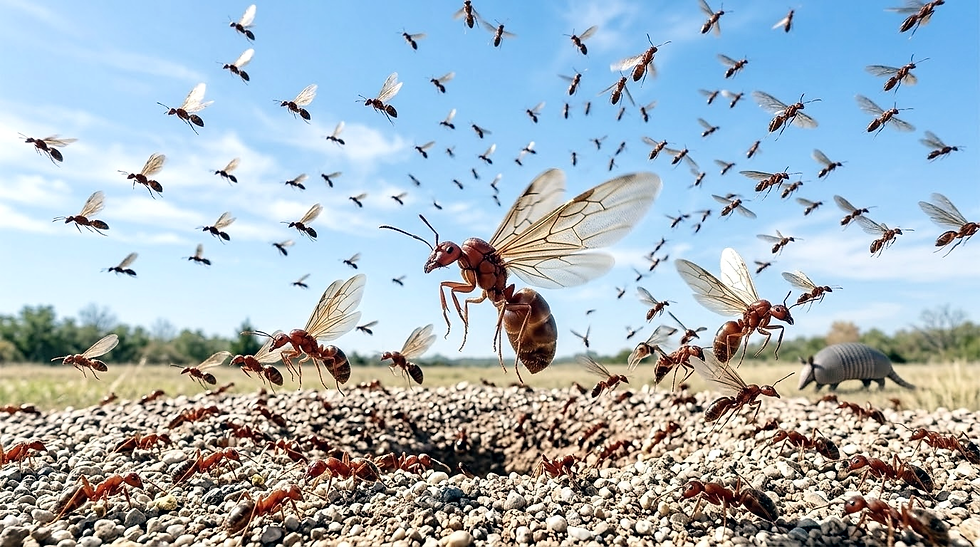
The princess surged up the tunnels, bursting out into the blinding sunlight. The bare-earth mound was a scene of absolute chaos. Hundreds of her winged brothers and sisters were launching themselves into the breeze. Spurred by a sudden, overpowering instinct, she flexed her wings eagerly and leaped into the air.
Gathering in the Sky
She flew upward, riding the thermal heat waves radiating off the baked clay. Tracking a dense column of insects on the horizon, she flew toward a solitary, towering mesquite tree. There, the sky was thick with a swarming, chaotic cloud of thousands of alates from across the valley. It was a genetic melting pot and a lethal buffet for local birds, but the princess had only one directive.
The moment she entered the swarm, she was beset by winged kings. The mid-air mating was a violent, bruising scramble. Drones collided with her in rapid succession, grappling her armored thorax with their legs. She mated with twenty different males in a frantic, tumbling flight, absorbing and locking away millions of sperm cells into her internal spermatheca. This microscopic biological vault would be the sole engine of her kingdom, sustaining a lifetime of egg-laying. The drones, their singular purpose fulfilled, dropped to the grass to die. Her wings frayed and burning with exhaustion, the princess plummeted back down to the mowed meadow.
The royalty of the air was over; the brutal gauntlet of the ground had begun.
Her body surged with a new, frantic directive. She walked backward against a jagged limestone pebble, deliberately snapping her own wings off at the hinges. She no longer needed them. Deep within her chest, her massive flight muscles began to dissolve, converting into a rich internal fat reserve that would keep her alive for months without food.
As she searched the baking dirt for a place to dig, a familiar scent drifted across her antennae. It was the distinct, weathered pheromone of her own kind, but it smelled wrong. It smelled faint, stagnant, and decaying.
Guided by the scent, she stumbled upon a massive, cleared circle of earth—a giant harvester ant bed. But there were no patrollers guarding the perimeter. A few elderly worker ants wandered aimlessly across the clearing, their movements sluggish and confused. Their queen had died months ago. Without her pheromones to give them purpose, the colony was functionally dead, waiting for the end. The princess did not hesitate. She marched straight down the main entrance hole.
Chemical Standoff
Instantly, the darkness turned hostile. Two elderly workers, alerted by her foreign colony aroma, rushed her in the narrow tunnel, their heavy jaws snapping and drawing a droplet of clear hemolymph from her leg. The princess was larger and stronger, but killing them would ruin her chance at an empire. She tucked her legs tightly beneath her armored body, forming an impenetrable seed-like shield, and began to groom herself frantically.
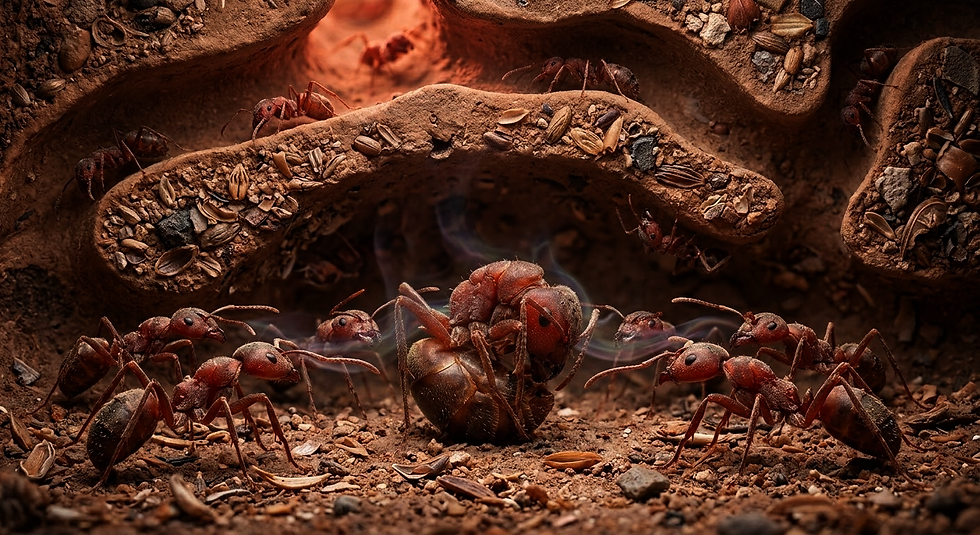
With every pass of her legs, she released a flood of her own fresh queen pheromones into the cramped tunnel. For three days, she lived in a collapsed side chamber, locked in a silent, chemical war of attrition. Whenever a worker approached with jaws agape, the princess didn't fight; she sprayed a mist of cuticular hydrocarbons—the chemical "perfume" of absolute royalty.
Slowly, the magic of chemistry took hold. The leaderless, desperate workers began to confuse her potent scent with the memory of their lost mother. Their aggression softened into curiosity, then into submission. They began to groom her, licking the very armor they had tried to pierce. On the fourth day, a worker approached the princess not with snapping jaws, but with a droplet of regurgitated water. She had been accepted, and she was thirsty.
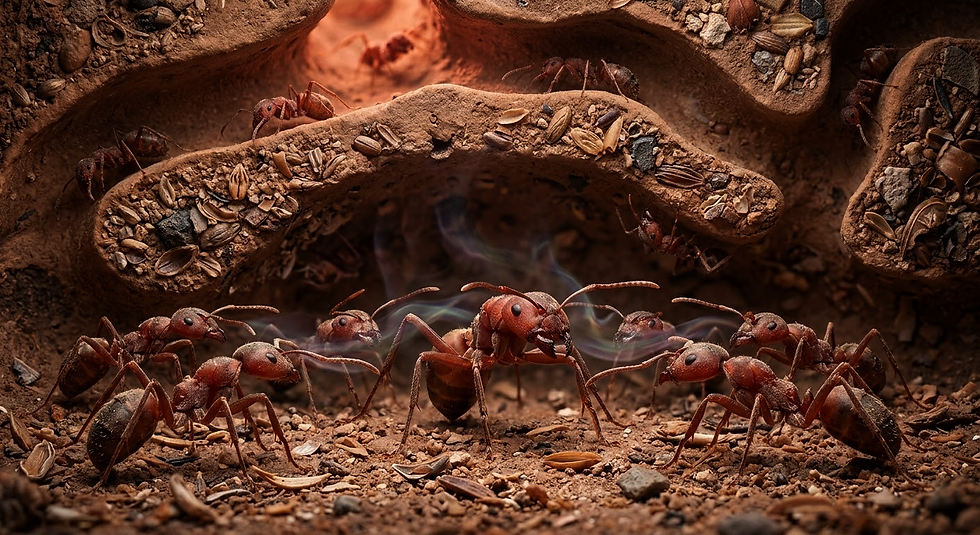
Safely ensconced in the ancient royal chamber, ten feet beneath the Cross Timbers soil, the new queen laid her first small cluster of eggs. The surviving elder workers immediately gathered them up, tending to them with newfound vigor, their life purpose renewed. Weeks later, the first of her own biological offspring hatched—tiny, pale workers. Alongside the fading remnants of the old empire, the new queen's daughters began to clear the tunnels and harvest the seeds and edible flesh of a new century.
Raid from the North
By the following summer, the colony was functioning, but fragile. The adopted workers were dying of old age, and the queen's first true generation of daughters was still small. That vulnerability did not go unnoticed.
Two hundred feet away across the now bone-dry stream bed, a massive, rival harvester colony ran out of foraging space. Their scouts detected the weak chemical perimeter of the queen's nest. They didn't just launch a frontal assault; they deployed a diabolical, predatory tactic: chemical warfare through mimicking alarm pheromones.
A vanguard of hundreds of rival raiders marched onto the queen's cleared mound. Instead of biting, they began to violently vibrate their abdomens against the earth, releasing massive clouds of a highly volatile chemical compound. To the queen's young, inexperienced workers, this scent smelled exactly like an overwhelming, catastrophic invasion of an invisible, apex predator. It was a chemical illusion designed to trigger mass panic.
Inside the tunnels, chaos erupted. The queen’s young defenders, blinded by the false alarm pheromone, began running in panicked circles, discarding their seeds and abandoning the tunnels. The raiders poured down the main shaft, marching over the disorganized defenders, headed straight for the seed vaults and the royal chamber to slaughter the new queen.
But the invaders had underestimated the ancient architecture of the 50-year-old fortress.
As the raiders squeezed into the deep bottleneck tunnels, the queen’s oldest adopted workers—veterans of decades of border wars—did not panic. Their weathered antennae were less sensitive to the false chemical alarm. Recognizing the true physical threat of the invading bodies blocking the air vents, these giant, ancient workers formed a living wall.
They threw their heavy, scarred heads forward, blocking the narrowest chokepoints of the tunnel like biological corks. Behind them, the queen's younger daughters rallied, recovering from the chemical panic as the airflow cleared. They swarmed over the backs of their older sisters, using their sharp stings to inject formic acid into the joints of the invading force.
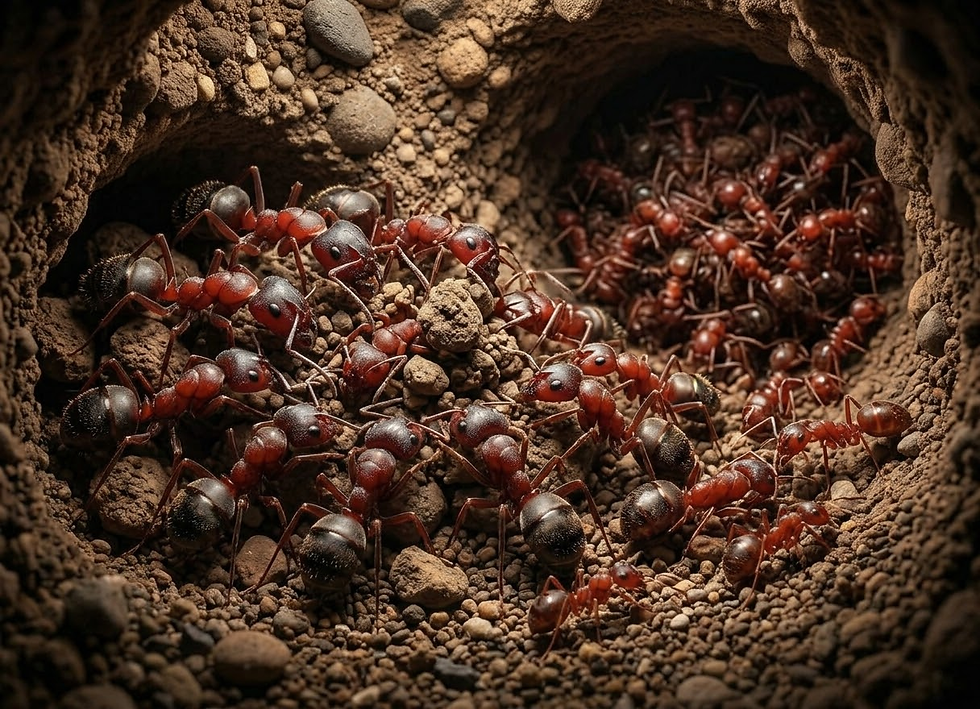
For two brutal hours, the bottleneck held. The raiders, suffocating in the deep tunnels and unable to bypass the living wall of defenders, began to take heavy casualties. The false alarm pheromone dissipated, losing its power. Realizing the psychological trick had failed and the cost to seize the fort was too high, the remaining raiders sounded a retreat, dragging their dead back up into the pounding glare of the summer sun.
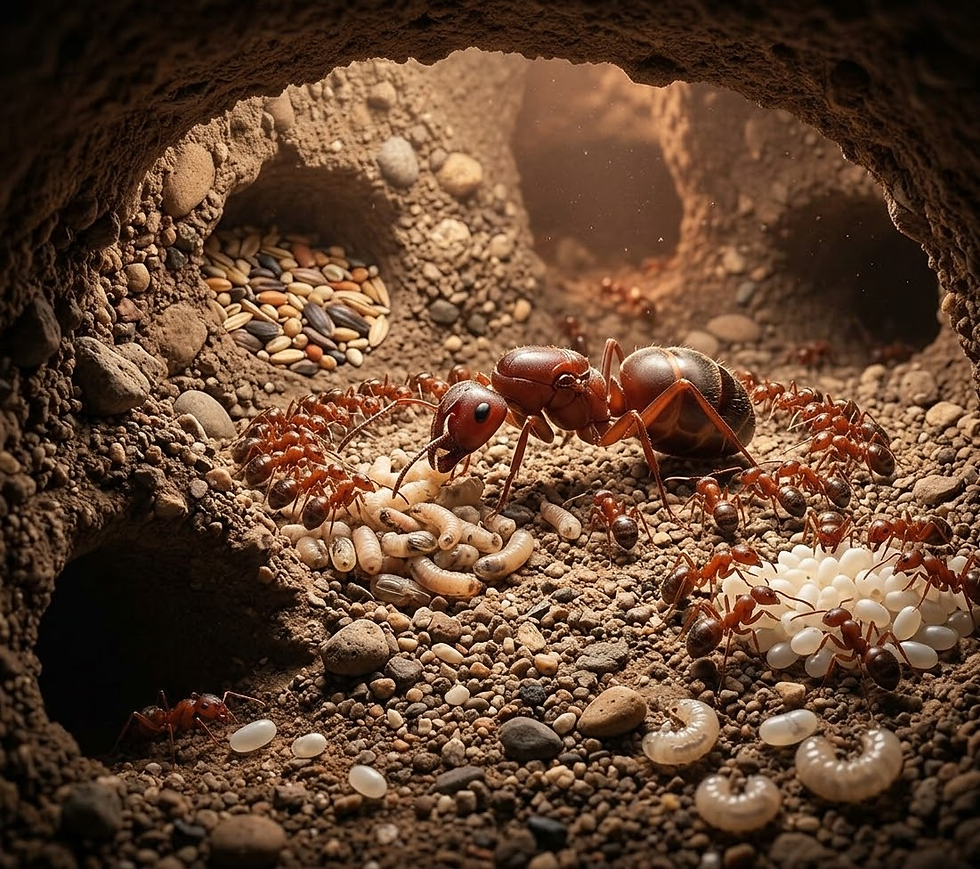
Deep in the bedrock, surrounded by her victorious daughters and the few remaining elders, the queen felt the vibrations of the retreat subside. She stroked a freshly laid batch of eggs with her antennae. Her lineage had been tested by fire and chemistry, and the ancient nest belonged to them.
Epilogue
The autumn air cooled the lower layer of air settled over the Cross Timbers meadow, but deep below the soil, the queen's royal chamber vibrated with a newfound, frantic momentum. Her gamble had paid off. The chemical coup was complete, and her first massive generation of true daughters had finally reached adulthood. They were larger, stronger, and more coordinated than the fading remnant of the old empire. As the seasonal winds began to shake the valley, the meadow offered up its greatest bounty.
Just eighty feet from the mound stood the ancient hackberry tree, its warty, island-ridged bark holding fast against the autumn breeze. From its canopy, a steady rain of tiny, dark-purple fruits plummeted into the mowed grass.
To the young colony, this was a declaration of wealth. The queen’s foragers established a massive, permanent trunk trail—a cleared highway stretching straight from the mound to the root flares of the great tree. Thousands of worker ants marched in perfect, unbroken lines, scaling the fallen debris to claim the prize. They gnawed away the sugary, date-like pulp on-site for a quick blast of carbohydrate energy, then hoisted the hard, mineral-rich internal seeds into their jaws, carrying them back to the fortress.
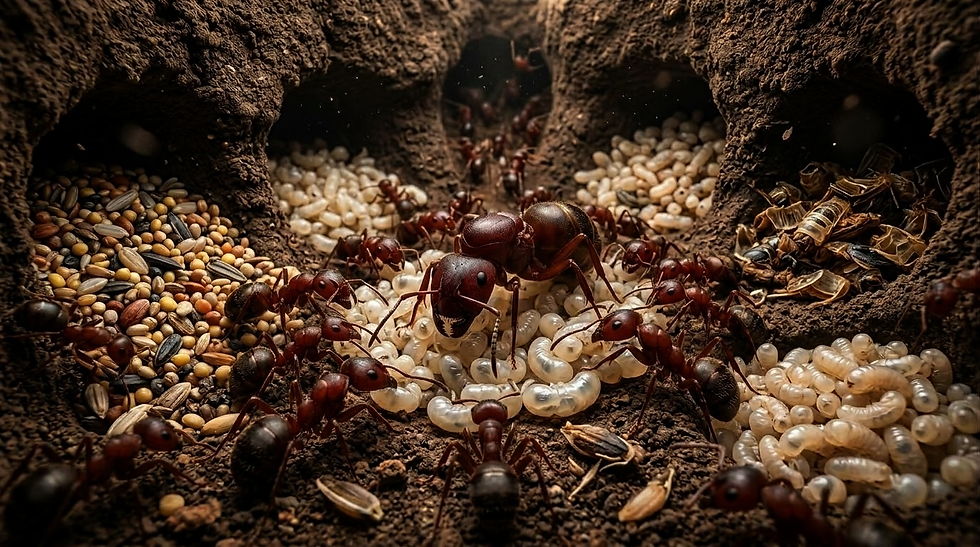
Inside the upper granaries, the nest became an industrial mill. Workers used their powerful, square mandibles to crack the stony hulls, churning the rich inner kernels into a high-protein "ant bread." Fed on this superb hackberry diet, the queen's egg production exploded. The larvae grew rapidly, and the colony’s workforce swelled from a few hundred to tens of thousands.




Comments